This is part 4 of our series on how Gylder works. In the previous post, we covered crypto tracking. Now let's talk about everything that doesn't have an API.
The gap in automated tracking
Bank accounts sync automatically. Crypto exchanges connect via API keys. But what about your house? Your car? Your pension? Physical gold? A student loan?
These assets and liabilities are a significant part of most people's net worth — often the largest part. A house alone can be worth more than all your other assets combined. If your tracker ignores these, your net worth figure is incomplete and misleading.
Manual entries fill the gap
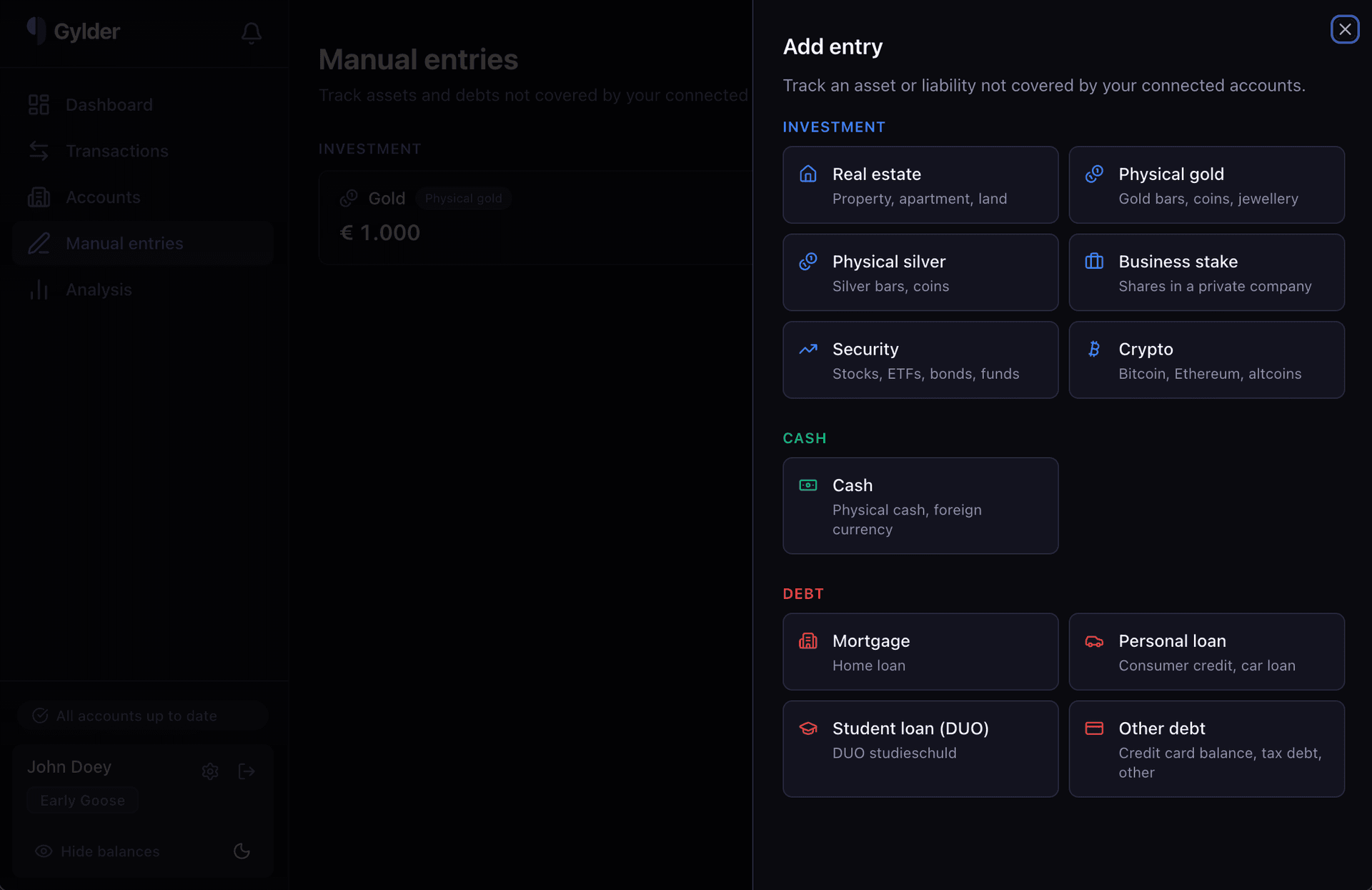
Gylder lets you add any asset or liability that isn't covered by your connected accounts. When you open the manual entry screen, you'll see a preset picker with the most common types:
Investments
- Real estate — Property, apartments, land
- Physical gold — Gold bars, coins, jewellery
- Physical silver — Silver bars, coins
- Business stake — Shares in a private company
- Security — Stocks, ETFs, bonds, funds (for brokers we don't connect to yet)
- Crypto — For exchanges we don't support yet
Cash
- Cash — Physical cash, foreign currency
Debts
- Mortgage — Home loans
- Personal loan — Consumer credit, car loans
- Student loan (DUO) — DUO studieschuld
- Other debt — Credit card balances, tax debt
How it works
For each manual entry, you provide a name, a value, and optionally some metadata. For debts, you can add the lender, monthly payment amount, and start date — Gylder uses these to estimate your payoff timeline.
Once created, manual entries appear on your dashboard alongside your connected accounts. They count towards your total net worth, show up in your asset allocation breakdown, and appear in your portfolio view.
Keeping values up to date
Unlike connected accounts, manual entries don't update automatically — you set the value and update it when things change. For assets like property, updating once or twice a year is usually enough. For debts with regular payments, you might update monthly.
The key benefit is that even an approximate value is better than leaving it out entirely. A house worth "roughly €350,000" gives you a far more accurate net worth than pretending it doesn't exist.
Debts matter too
It's tempting to only track assets — the things that make your net worth look good. But debts are equally important. A €400,000 house with a €350,000 mortgage contributes only €50,000 to your net worth. Without tracking the mortgage, you'd overstate your wealth by €350,000.
Gylder's dashboard shows debts as a separate category with a clear breakdown. For each debt, you can see the outstanding balance, the lender, your monthly payment, and an estimated payoff date based on your current payment schedule.
The complete picture
With bank accounts connected, crypto exchanges linked, and manual entries filled in, your Gylder dashboard finally shows the full picture. Every asset, every liability, every account — in one place.
This is the foundation everything else builds on. In the next post, we'll look at how Gylder breaks down your portfolio and shows you exactly where your wealth is distributed.